The swell jumps, and suddenly your favorite shortboard feels like a different board. You are paddling hard but arriving late, or making the drop only to wish for more grip once you gather speed. That is a better reason to consider a step-up than a forecast with a big number on it.
A step-up is a board for surf in which your everyday board gives away too much entry, hold, or control. It is usually longer, but “my shortboard, only longer” is an incomplete shopping brief. The wave's shape and your own surfing determine whether you need one at all.
Notice the limit of the board you know
Think back over several sessions in waves you were ready to surf. Did the board catch the wave, but only after the drop had become awkward? Did it feel skittery or hard to settle on a fast face? Were you unable to hold a useful line through a powerful turn? Those are equipment questions worth exploring. If you were choosing the wrong peak, hesitating at takeoff, or out of your depth, a new board cannot solve those problems for you. Surf Simply's coaching guide to bigger waves is candid about confidence, familiarity, and preparation being separate from equipment.
Also ask how often this happens. If one exceptional swell a year exceeds your board's range, borrowing or renting may be smarter than owning a specialized shape. If your local point or reef regularly serves up fast, powerful waves, a dedicated good-wave board can fill a real gap. And if your current board still gets you in, holds a line, and turns where you want in those waves, you may already have enough board.
What a step-up changes
The extra rail length and carefully placed foam are meant to help you enter the wave and keep a controlled line. A narrower or more pulled-in tail can offer hold where a wide small-wave tail feels lively for the wrong reasons. Rocker and rails matter as much as length: the board must both fit the curve of the wave and stay usable at speed.
The makers' descriptions show why there is no single step-up recipe. Channel Islands' Happy Traveler carries thickness forward to help paddling, while its back third is straighter and more pulled in for control. The brand pitches it as a versatile board for good and bigger surf, including days when the swell eases. Its CI Pro Step Up is a more performance-focused extension of the CI 2.Pro, intended for steeper, more critical waves. Channel Islands explicitly calls it the more advanced choice of the two.
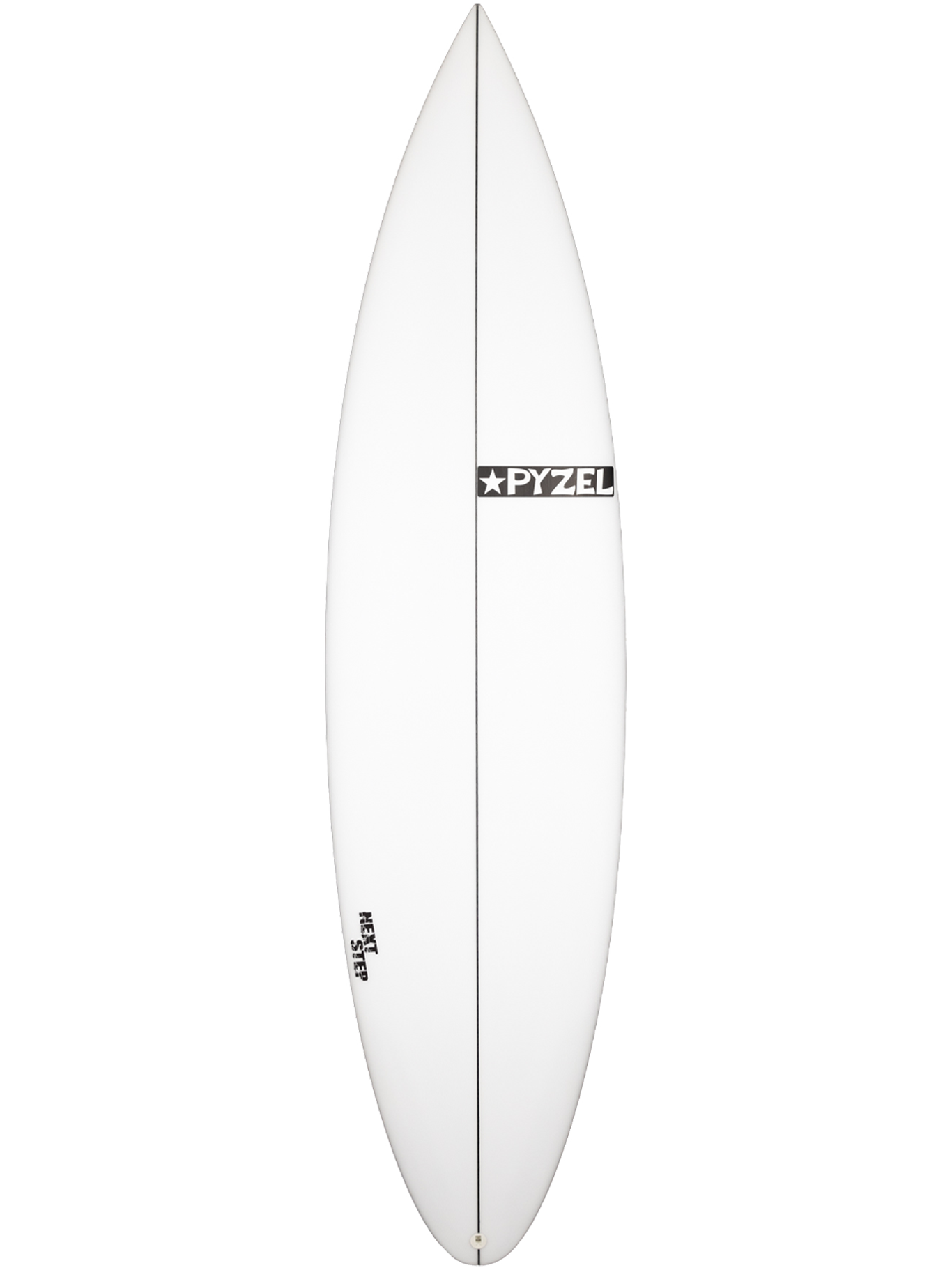
Pyzel's Next Step takes another approach: more rocker for steep drops, some thickness through the nose for paddling, and refined rails for control. The maker describes it as a move up from a shortboard for solid surf. Its Ghost spans a broader good-wave range; a surfer might size one as an everyday good-wave board or a modest step-up. These are design intentions from the shapers, not a claim that any model will feel the same under every surfer.
Use the board you already ride as your ruler
Bring your daily board's dimensions and the waves it handles well to the conversation. That is more useful than arriving with a target liter figure alone. A longer board can have a relatively narrow tail and refined rails; a shorter one can hide a surprising amount of foam under the chest. The Happy Traveler stock chart lists its 6′4″ at 34.3 L, while Pyzel's Next Step lists its 6′4″ at 30.2 L. Equal length does not make them the same purchase. Check the outline, rocker, rail, fin boxes, and the exact board you can buy.
The shapers give model-specific starting points rather than a law for every step-up. Channel Islands recommends its CI Pro Step Up 2–4 inches longer than a rider's standard CI 2.Pro; Pyzel suggests the Next Step 2–8 inches longer than a rider's shortboard, with added thickness. Those ranges describe different models and different briefs. They cannot tell a stranger which size suits their paddling, wetsuit, waves, or ability. Pyzel also notes that step-up and gun boards may need more volume than a basic performance board, while warning that its volume calculator is an estimate.
Pick the kind of stronger surf you mean
“Bigger waves” can mean a clean, open point with time to set a line or a steep, fast beach break where you must fit the board into a tighter pocket. Tell a local shaper or good shop which break you mean, what your current board does there, and where it falls short. The answer may be a versatile step-up such as the Happy Traveler, a more specialized shape like the CI Pro Step Up or Next Step, or no new board yet. The Board Hogs catalog lets you compare the actual models; you can also inspect the Happy Traveler, CI Pro Step Up, and Next Step side by side.
Do not confuse a step-up with a gun. Pyzel describes its Padillac as a dedicated big-wave design with a long size range and a different job from the Next Step. Buying far beyond the waves and skills you have now can leave you with a board that spends its life in a bag.
Make the decision before the big day
If possible, borrow or demo a candidate in clean, manageable surf first. Learn where your feet belong, how it paddles, and how it turns before you ask it to do its hardest work. Surf Simply makes the same point about getting to know a step-up before a major swell. Check your fin setup and the board's condition, too, especially if buying used.
Choose a step-up when stronger waves you can surf routinely expose a repeatable limit in your daily board's entry or control. Wait when the board is still doing its job, the problem is positioning or confidence, or you cannot describe the waves the new board must serve. The right step-up extends a quiver you already understand; it does not grant access to conditions you have not prepared for.