Design + Construction
Although much of the board’s riding characteristics can be attributed to the outline, one must realize that it is simply one element in a much larger assemblage of contents that makes up…
View on Harbour Surfboards's siteNo reviews yet. Be the first to review the Design + Construction.
From the lineup
Reviews
No reviews yet. Be the first to review the Design + Construction.
About
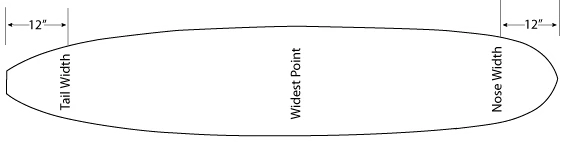
Although much of the board’s riding characteristics can be attributed to the outline, one must realize that it is simply one element in a much larger assemblage of contents that makes up the final shape. But each of the three measurements does provide its own defining contribution to the board’s performance, and with that contribution usually comes some sacrifice to another aspect of the board’s performance. For example, as the nose becomes wider, it becomes more stable to stand there. The down side of this is that widening the nose adds more volume of material or swing weight in front of you while turning, so the ease of turning diminishes. When the surfboard drops into a wave, a wider the tail will captures more water, thus causing better lift. As the tail design gets wider it becomes more and more stable but this will make it difficult to tip on an edge to turn. Boards that are wider in the mid section are more stable but are more difficult to turn because they don’t tip up on a rail as easily as their narrower counterpart. The three measurements work in concert, and as one grows or reduces, it affects the others. If the nose and tail remain the same and the center width increases, the board gains stability. As the board gains stability, it also gets more difficult to tip on a rail to turn. Conversely, if the nose and tail increase in width and the center remains the same, the rails become more parallel, complimenting the nose ride but decreasing the maneuverability because there is little curve to cause drag in the turn. Increase the nose width and leave the other dimensions alone and it moves the wide point forward, reducing the center curve, making it more difficult to turn. Increase the tail dimension, and decrease the nose width, and it will make for great turns, but the board will be slow and a poor nose rider. (Note: all degrees are Fahrenheit) Many things have been said about how long a board needs to cure before it is ridden. For the first 48 hours resin is very soft. Severe dents will occur wherever pressure is applied to the surface. Most boards are laminated one day, hot coated the next day, and sanded the following day. Severe denting is generally not a problem with glossed and polished boards. The gloss and polish process usually takes an additional several days, making about 5 to 6 days from the day it was laminated. The lamination process is the application that most needs to resist denting. If you wait an additional week after polishing the board will be reasonably cured. This time estimate is based on a typical 70-degree ambient temperature. If it is the dead of winter, and days and nights are very chilly, the waiting period can double or triple. Conversely, heat can greatly accelerate the curing process. Your board, exposed to about 115 degrees heat for several hours, will be adequately cured. Reliable sources tell me that this rapid cure actually increases the strength. Surfboards that are already cured cannot be made stronger by this process. Be very careful not to let the board get over 125 degrees. Polyester resin actually begins to soften at about 150 degrees. Foam begins to get unstable at 130 degrees. Down turned rails are about 75% down in the middle of the outline, with a soft roll, quickly blending into a flat bottom. They usually change to full down turned rails with a hard edge about 20 to 24 inches from the tail. This is the area that the outline shape makes the transition into the tail curve. The hard edge in the tail area of the down rail board will grip the water allowing for fin designs with less total area. A fin should be of less volume on a board with hard tail rails than on a board with 50/50 rails. This is because the edge on a board with down tail rails is, along with the fin, gripping the wave. Boards with a down tail rail and a soft low mid rail, will initiate cut-backs better due to the fact that water isn’t being trapped by wrapping the rail. They give more tail lift, and this m